Hotel Sourcing: Why CPOs and Procurement Leaders Must Rethink their Hotel Category Sourcing
In Europe, indirect procurement teams are facing shrinking budgets and rising off-channel hotel bookings. In the post-Covid World, the travel management function and travel procurement have been asked to focus on what really matters and divest from transactional and low-value-added activities. In recent years, at major corporations, cost control has become a major area of concern. See the following research publications from Deloitte and McKinsey highlighting these shifts: future-of-business-travel-post-covid and the-comeback-of-corporate-travel-how-should-companies-be-planning.
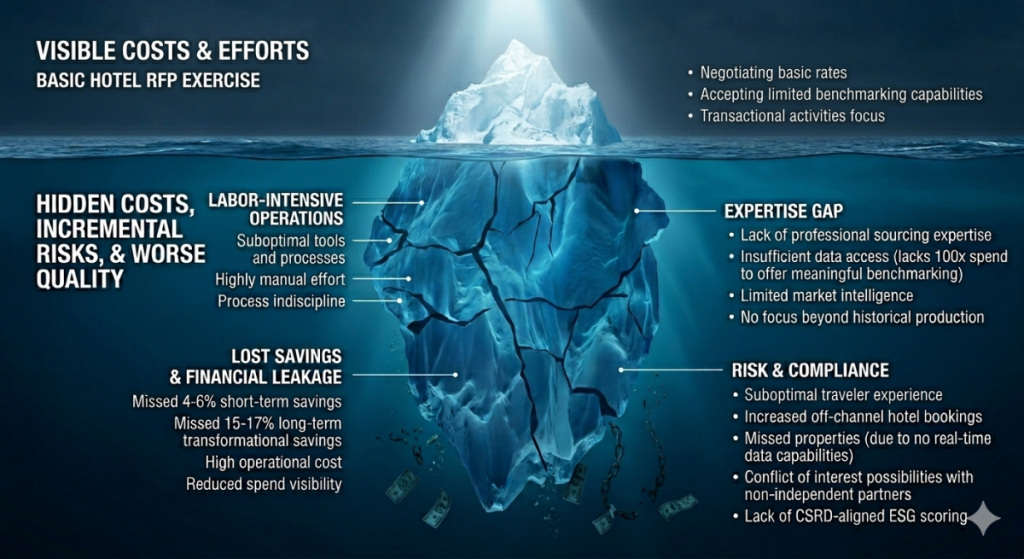
How can teams manage hotel sourcing amid these pressures? Many travel teams have been doing it in a highly labour-intensive way with suboptimal tools and processes, focusing on the very transactional aspects of the exercise and accepting limited benchmarking capabilities. Outsourcing parts of the whole hotel category sourcing activities offers interesting benefits.
Key Factors to Consider When Assessing Readiness
For Hotel sourcing, like for any other indirect category, it is indispensable to write up how it is linked to and how it supports wider company objectives, including cost pressure dynamics, productivity, sustainability, employee experience, etc.
Parts of or the whole process of the hotel sourcing exercise can be easily outsourced. According to McKinsey’s Indirect Outsourcing Decision Matrix, the existence of internal capabilities and strategic importance should define the decision on what to outsource. Internal capabilities are assessed at both the organisational level (tools, processes) and individual level (skills, mindsets). The strategic importance of a category is determined by evaluating whether it drives competitive advantage, its business proximity, and the outsourcing risk.
The key factors to consider for hotel sourcing are the following –
- understanding the granular needs of key traveller profiles,
- the expertise in hotel category sourcing,
- the process discipline,
- access to the latest sourcing applications/tools and tech,
- cost advantages,
- market intelligence.
These value-adds are expected to result in faster time to impact, increased spend visibility and compliance, and reduced operational cost.
According to McKinsey’s research, in the short-term, the overall expected savings coming from indirect category outsourcing activities amount to 4-6% per year. When it comes to the long-term assessment, the more transformational aspects will drive, on average, 15-17% savings per year. The travel category – including hotel – is a more volatile, fragmented, dynamically priced supplier market, where travellers have a heavy influence. Nevertheless, with the above reservations, the McKinsey indirect category outsourcing savings figures can be directionally applied to hotel category outsourcing.
When selecting the right partner for outsourcing, corporates also need to think about how a potential partner ticks the box of a party without any vested interests. If the selected party has a conflict of interest in the sourced category, then it is likely that the outcome will also be impacted by this conflict.
So, what would a Procurement Team need to consider when contemplating the idea of outsourcing the hotel category sourcing activities, and more specifically, part of the hotel RFP?
We wanted to provide a few practical aspects to facilitate the task, so we interviewed Guillaume Ridolfi, Group Chief Commercial Officer of S4BT. His recommendations and callouts are the following –
What CPOs must consider when envisaging outsourcing Hotel Sourcing / Hotel RFPs
- Hotel sourcing is a profession. The customer cannot and should not master it. It requires professional expertise, and it does not naturally sit on their side.
- The outsourcing of hotel sourcing cannot be absolute; there should be clear boundaries set around it. How do I make sure our objectives are clearly articulated and the roles and responsibilities around who owns what are also clear?
- Once the above clarity is achieved, how do we select the most appropriate party to work with? The terms “co-creation” and “orchestration” are the most reflective ones to describe effective partnerships between client-side procurement teams and consulting firms in this space. How do we select the party with whom we can achieve a high levels “co-creation” and “orchestration”?
- The right governance is a key success factor in the process. Client-side Procurement teams need to stay in the lead in all outsourced models. How can we create the right governance and establish the right controls and guardrails to achieve that?
- The consultant’s essential contribution is to provide expertise on how the market works. The benchmark is an essential decision-making tool.
- An often-overlooked factor of the benchmarking exercise when choosing a partner is how much data the party has access to. If the partner does not have access to sufficient levels of data, including corporate and public rates, then the outcomes will not reflect the market realities. The recommendation is to have 100 times the spend of a customer to be able to offer meaningful benchmarking.
- Tap into the best and most contemporary tools – how can this be achieved?
- Because of the nature of hotel contracts, a yearly hotel sourcing exercise is needed. Multi-year contracts are an option, but rate realities change by design every year, because that is how hotels commercially operate.
- When negotiating rates, there should be a focus beyond the historical production on current patterns and production. Therefore, real-time data capabilities are also key to effectively manage the program and not miss out on properties which may not have qualified for the program merely based on history. Also, during the lifetime of the contract, real-time changes and new production would equally trigger new rates.
- There needs to be a dissociation of how the overall value of the program is assessed based on –
- Negotiated rates
- Real production, which also reflects access to inventory, actual utilisation of rates, conditions and ancillaries, per channel utilisation, realities around last/non-last room availability, blackouts, real production with best buy, OTA, direct supplier rates.
So, in a summary: outsourcing is not only necessary – it is a must!
The Independent Path Forward
If the above blog has inspired you, please consider Odyssey’s unbiased sourcing expertise. AI-powered RFP automation, GDPR, CSRD-aligned ESG scoring—unlocking significant net savings without conflicts of interest.
Next Step: Book a 45-minute diagnostic call to benchmark your hotel program against peers and model ROI.
Contact LinkedIn linkedin.com/in/daniel-tallos